



Connect with our decommissioning experts
Assessment guide
Ready to de-risk your decommissioning waste chain?
Managing multiple waste streams, contractors and receiving facilities is complex enough. Gaps in permits, treatment capacity, transport or documentation add risk, and if they aren’t caught early, materials sit on the quayside, costs rise and schedules slip.
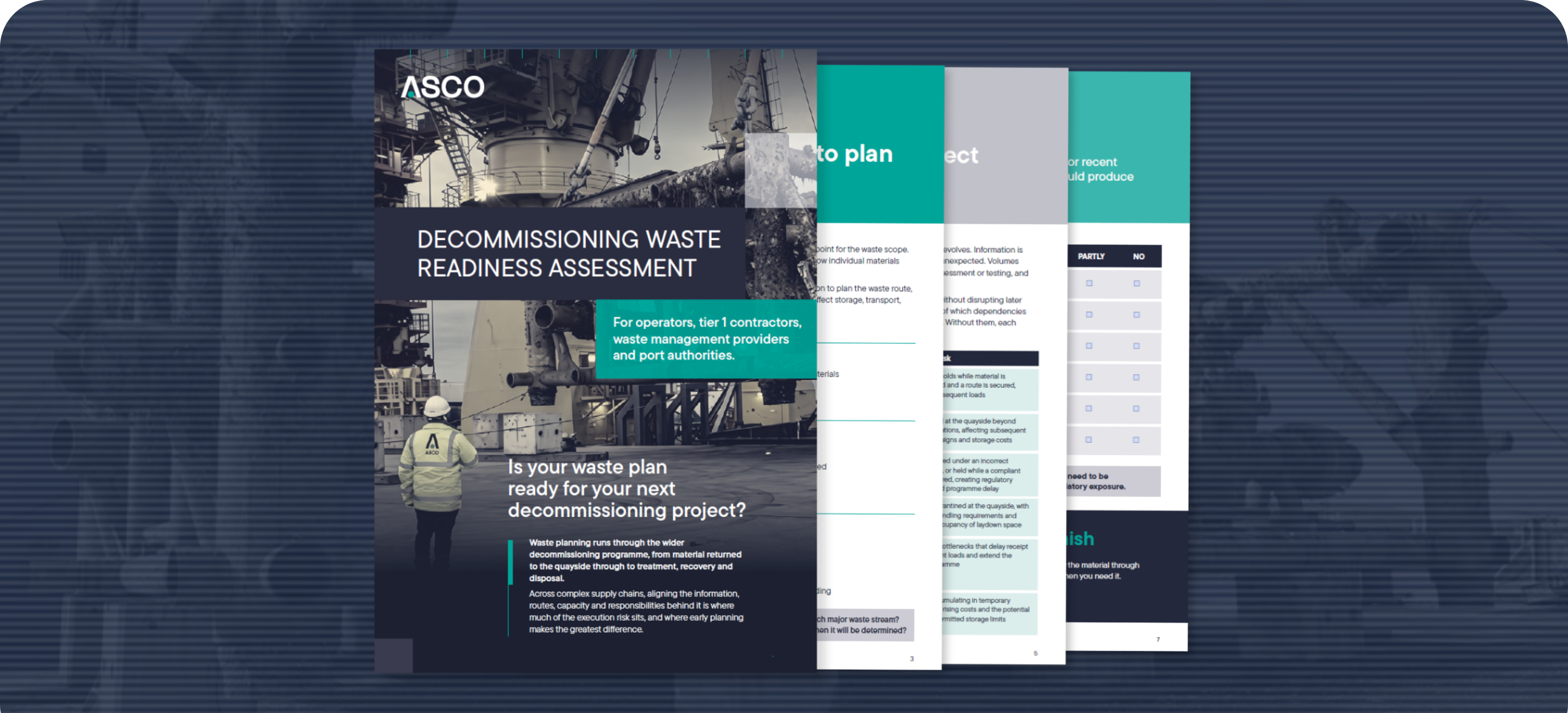
Our assessment helps you take a closer look at your onshore waste chain, from quayside operations and dismantling through to NORM assessment, storage, transport, treatment, recycling and disposal. It identifies potential gaps and areas of risk, helping you address issues before they affect project delivery:
- Waste scope: Confirm you have the information to define each waste stream, including NORM and hazardous materials, and what still needs testing.
- Waste routes: Check that permits, capacity and logistics are in place from quayside receipt to final destination.
- Changes in scope: Plan how the waste plan responds when volumes, classifications or routes shift.
- Traceability: Test whether you could produce the records regulators expect within 48 hours.
One accountable partner for your onshore chain
ASCO offers end-to-end management, from materials and shipments to handling complex waste streams with full traceability, we deliver the control and visibility needed for efficient, risk-free decommissioning.
Got a project coming up?
Proven across complex scopes
Kelly Smith
Group Head of Environmental and Decommissioning
Kelly has over 15 years of experience in the oil and gas services industry, specialising in environmental and waste management, operational delivery and business growth. She leads the Environmental and Decommissioning service line across the UK and supports international projects.

James Gordon
Business Development Executive - Environmental and Decommissioning
James has over 30 years of international experience in the energy sector, specialising in business development, operational delivery and client relationships. He leads growth initiatives for ASCO’s Environmental and Decommissioning services across the UK, supporting opportunities across energy, renewables, construction and defence.

What happens to offshore decommissioning waste when it reaches the quayside?
Recovered material is received, weighed and inspected, then moved into a processing area. Depending on its condition, it may need marine growth removal, NORM monitoring, cleaning, decontamination or downsizing.
It is then segregated by waste stream and transported to permitted treatment, recovery or disposal facilities. Each stage needs confirmed permits and capacity, and records need to follow the material through every handover, so a bottleneck at one point doesn’t leave material held on the quay and delay the next vessel campaign.
How much of a decommissioned offshore structure can be recycled?
Usually the large majority by weight, because most of the material is steel and other recoverable metals. ASCO found this on a 400-tonne subsea isolation valve recovery, 99% of the material was recycled and only marine growth went to landfill.
Recovery rates depend heavily on early assessment, effective NORM decontamination and good segregation. Contaminated or poorly characterised material is more likely to end up in specialist disposal routes.
Can NORM-contaminated decommissioning material be recycled?
In most cases, yes, once it has been decontaminated. NORM is usually confined to scale and sludge on internal surfaces, so the steel itself can often be recovered. Items are radiologically assessed and then decontaminated at a permitted facility, typically by high-pressure water jetting under controlled conditions.
They are then re-monitored to confirm they meet the levels for release before going to recycling. The removed scale and sludge are managed separately as radioactive waste. Offshore monitoring at recovery helps here - it identifies contaminated items before they reach the quay, so they can be segregated straight away and clean material goes directly to recycling.
When should NORM monitoring start on a decommissioning project?
Before material reaches the quay. Reviewing production records and previous NORM surveys during planning helps predict which components are likely to be contaminated. Monitoring offshore at recovery then confirms findings early, so the receiving port can prepare containment, segregation and a decontamination route in advance. If NORM is first identified at the quayside, the material is typically quarantined while it is characterised, which ties up laydown space and can delay subsequent vessel calls.
Who regulates decommissioning waste in the UK?
OPRED approves the decommissioning programme. It also requires an active waste management plan throughout execution and expects a close-out report within a year of offshore work finishing.
Once waste is onshore, SEPA regulates it in Scotland, covering site authorisations, duty of care records, special waste consignments and NORM. The Environment Agency regulates the equivalent activities in England, including hazardous waste consignments and NORM permitting. Quayside and processing sites must be permitted for every activity carried out there, from storage to cutting.
What records are needed for decommissioning waste traceability and close-out reporting?
The key records are:
- weights and descriptions recorded at receipt and matched to the offshore inventory
- hazardous and NORM test results linked to the material they relate to
- transfer or consignment notes for every movement between sites
- confirmation of receipt and treatment method from each facility
- recovered, recycled and disposed tonnages reconciled against the original inventory